
With absorbable threads, it is possible to redefine facial contours and promote collagen production in the skin. The result is a natural lifting effect without surgical intervention.
This gentle method has a very short treatment duration and can be excellently combined with other minimally invasive therapies.
Important Facts
- Treatment duration: 15-30 minutes
- Anesthesia: none
- Aftercare: Cooling, sun protection, no dentist in the coming week
- Result: Immediately visible, intensifies over time and lasts up to 2 years
- Pain level: Low, only tiny punctures with very fine cannulas
- Social readiness: Immediate
- Price: from €390
What are PDO Threads
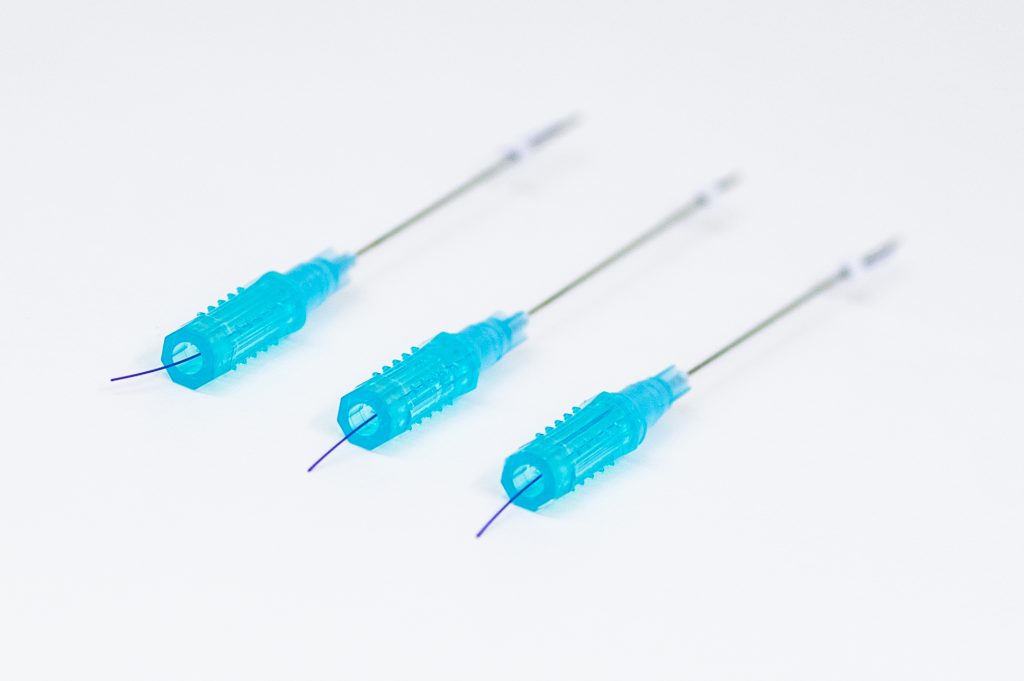
In the so-called PDO thread lift, sterile threads made of PDO (polydioxanone) are inserted under the skin using extremely thin hollow needles and fixed there. The material has been used in medicine for many years, for example for absorbable surgical sutures. The threads are broken down into water and carbon dioxide over a period of about 12-18 months.
How Does Thread Lifting Work
There are two types of thread lifting.
1. Simple PDO Threads
This type of thread is inserted under the skin without tension and causes an immediate and long-lasting tightening of the face. On one hand, the threads create a smoothing of fine lines immediately after insertion through a volume effect, and on the other hand, they massively stimulate collagen production in the skin over many months, thus ensuring a significant and lasting skin tightening and a rejuvenating effect. This method is ideal for counteracting the first signs of facial skin sagging, as the body’s own collagen synthesis decreases more and more with age.
The effect of simple PDO threads is comparable to a grain of sand in a mussel: Because the grain of sand “disturbs” the mussel, it coats it with mother-of-pearl. Similarly, the skin wraps collagen around the thread, creating a slight lifting effect. After a few months, the thread dissolves, but the produced collagen remains.
These simple PDO threads are suitable for treating fine lines around the eyes, cheeks, or neck.
2. Threads with Barbs
If a stronger tightening and lifting effect is desired (for example, with noticeably sagging facial areas), stronger threads with small barbs are also available. Here, tension is actually applied to the tissue, and sagging facial regions are gently lifted. This can be very effective in treating early jowls without surgery or giving the jawline a youthful silhouette. The effect of the thread lift is immediately visible, and the treatment duration is very short compared to surgical methods. Also, unlike surgery, there are no scars. Just like the simple threads, the barbed threads also dissolve over time, but the facial contours remain fixed in the new position due to the newly formed collagen.
What is PDO Thread Lifting Best Suited For
- Small wrinkles on the upper lip
- Under-eye area
- Fine lines on the cheeks
- Jowls
- Chin
- Neck contours
- Vertical wrinkles on the décolleté
Advantages of Thread Lifting
- You have no downtime and are in principle socially presentable immediately after the treatment.
- No anesthesia is necessary.
- There are no incisions or scars.
- The result of a thread lift is immediately visible and lasts about 1-2 years.
- If needed, the treatment can be easily repeated, unlike surgical lifting.
- The method can be excellently combined with other treatments such as hyaluronic acid to achieve an overall harmonious and very natural result.
Thus, thread lifting is an extremely gentle method for all ages, associated with only minor risks. As long as there are no allergies or intolerances to certain surgical suture materials, the treatment is very well tolerated. Only small bruises, which can be easily concealed with makeup and disappear after a few days, occasionally occur. Any swelling can be treated with local cooling and usually subsides by the next day. A subtle feeling of tightness in the treated areas is normal and diminishes within a few days.
When Can a Thread Lift Not Be Performed
- Acute infections
- Skin inflammations
- Autoimmune diseases
- Allergies to surgical suture material
- Cancer
- Tendency to hypertrophic scar formation (keloids)
- Impaired blood clotting, therapy with anticoagulants
- Pregnancy
Frequently Asked Questions (FAQ) About Thread Lifting
Do I Need Anesthesia for Thread Lifting?
One of the biggest advantages of thread lifting is that it doesn’t require general anesthesia. This makes the procedure particularly gentle. Only local anesthesia is used at the insertion site. This eliminates the anesthesia risk for the patient, and she can leave the practice immediately after the treatment.
What Are the Threads Used in Thread Lifting Made Of?
The threads are made of polydioxanone, or PDO for short, a material that has been used for years in absorbable surgical sutures. The body breaks down the threads over months, and the end products are water and carbon dioxide.
Does Thread Lifting Leave Scars?
One of the great advantages of thread lifting is that no cutting is involved. Therefore, typically no scars are visible.
What Side Effects Can a Thread Lift Have?
As with any medical procedure, thread lifting can have unwanted side effects. That’s why I discuss all the risks and the pros and cons of the method with you in my practice. Together, we decide whether a thread lift is the best option for you, and what alternatives might also be considered.
The most common side effects are bruising and slight swelling, which subside within a few days. When using threads with barbs, small indentations in the skin may also occur for a few days, but these also disappear.
Rare side effects can include infections and wound healing disorders.
How Long Does the Thread Lift Take?
Plan for about 45 minutes to an hour for a thread lift. The procedure itself takes about 20 to 30 minutes, but you must also account for time for the consultation and photo documentation. Since not every patient is suitable for a thread lift, I recommend first booking a non-binding consultation. During this, we can discuss your wishes and ideas together and select the most suitable treatment.
Who Is Not Suitable for a Thread Lift?
In addition to general contraindications such as pregnancy, existing infectious diseases, wound healing disorders, or autoimmune diseases, which are all ruled out during the consultation, it’s also important to clarify whether the thread lift can meet your expectations.
Patients who complain about severely sagging facial contours may be better advised to have surgical lifting, as a significantly stronger lift is possible here. Also, if you desire strong tightening of the neck or jawline contours, surgery is the right choice.
Can a Thread Lift Be Combined with Other Treatments?
A thread lift can be excellently combined with other minimally invasive aesthetic treatments such as Botox or hyaluronic acid fillers. However, it is advisable to spread the various treatments over several appointments to minimize side effects and risks and to achieve optimal and natural-looking results.
For What Age Is Thread Lifting Suitable?
Generally, there are no age restrictions for thread lifting, assuming the patient is of legal age. However, very young patients simply don’t need it yet, as they don’t yet complain about sagging cheeks or other sagging areas of the face. For patients with significantly sagging facial contours, on the other hand, thread lifting may reach its limits, and surgical lifting might be advisable in these cases.
How Long Does the Effect of Thread Lifting Last?
The result of a thread lift lasts up to two years, depending on the treated facial region.
How many threads do I need for a thread lift?
It depends on the facial areas being treated. When using simple threads that promote collagen production, usually 10-20 threads are used.
When threads are used for a lifting effect to raise individual parts of the face, usually two to four threads are used per side.
Can a thread lift be repeated?
A thread lift can be performed multiple times if desired. With simple threads, collagen production in the skin is repeatedly stimulated, achieving sustainable skin tightening. With barbed threads, sunken facial areas can be gently lifted in multiple steps, achieving an overall fresher appearance without overly straining the tissue.
How quickly can you see the results after a thread lift?
In both cases, the result is visible immediately after treatment. With simple threads, the skin is plumped up due to the immediate volume effect. However, the improvement continues to increase in the following weeks and months because collagen production in the skin is stimulated.
With a thread lift using barbed threads, you also see the lifting effect immediately, but the final result can be assessed after about two weeks when any swelling has subsided.
What should you consider after a thread lift?
After the treatment, you should not apply makeup on the same day. For two weeks, you must avoid saunas, steam baths, and tanning beds, as you risk more severe swelling.
Facial care products must be applied very gently, and massages or aesthetic facial treatments should be avoided for about four weeks.
After a thread lift with barbed threads, it’s additionally important to sleep on your back if possible and avoid strong facial expressions. If necessary, food should be cut into small pieces.
What's better, surgical lifting or thread lifting?
This question can only be answered individually.
Stimulating collagen production with simple threads is a minimal procedure suitable for everyone and has a wonderful anti-aging effect over many months.
If a stronger lifting effect is desired, one has the choice between surgery and thread lifting with barbed threads. The advantage of thread lifting is that you don’t need anesthesia and have no scars. However, if you really want a strong lift of individual facial areas, surgical treatment by an experienced plastic surgeon is the more promising alternative.
Diese Behandlungsinformation wurde erstellt und medizinisch geprüft von Dr. Vjara Ilieva, Ärztin mit Schwerpunkt auf ästhetischer Medizin, Longevity- und orthomolekularer Medizin und Fachärztin für Radiologie.
Letztes medizinisches Update: Jänner 2026